


Creative Process for Cabane à Sucre
After developing a general concept for a cabane à sucre video featuring the Claude and Claudette characters, I jotted down a short list of ideas. Below is a screenshot taken from a Google Document.

After developing the initial ideas, I shared them with the executive director and assistant director of the Franco-American Centre, and they were very enthusiastic about the direction. From there, I wrote a full script, which they also approved, and then created several storyboard pages. Even though the storyboard wasn’t fully complete at that stage, I realized I needed to begin remodeling the characters to stay on schedule. I finished the character models first and then completed the remaining storyboard pages afterward. Since the script had already established the full narrative, there were no missing plot elements—I simply needed to finish illustrating the specific shots based on what was already defined in the script.
The most essential thing was remodeling the characters. The characters I modeled back in 2021 had flat and altogether improper topology which resulted in the characters having limbs thin as ribbons. Although others commented that it contributed to the claymation sort of style to the videos, in turn making them unique, I needed a complete overhaul that demonstrated I could learn and improve my understanding of character topology.
First, below shows what I was working with initially, in 2021.
2021


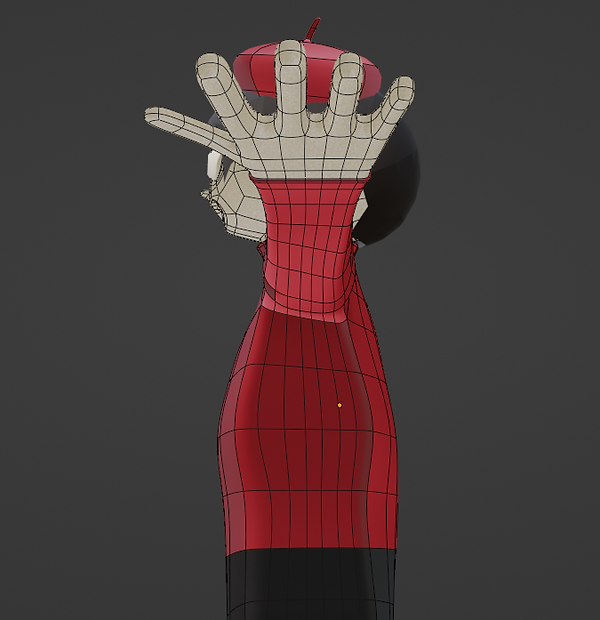


It was quite clear I had some work to do. And that's just what I did. I remodeled the characters using Blender, resculpted them into high-poly characters using ZBrush, and retopologized the characters into low-poly ones using Blender. But I couldn't have done it without the massive help from Mr. Hong Chan Lim's two-part 24-week 3D Character Modeling Workshop on Animation Mentor that I enrolled in throughout 2024. Just take a look at the difference!
2025


Additionally, I was working with different reference images this time. Back in 2021, I was working with these reference images. I sketched them in a T-pose facing front with pencil and paper. Unfortunately, I lost the original sketches.


Then the Claude and Claudette images were redesigned by another intern, and so I used these reference images with the redesigned characters in 2025 to remodel the Claude and Claudette characters.
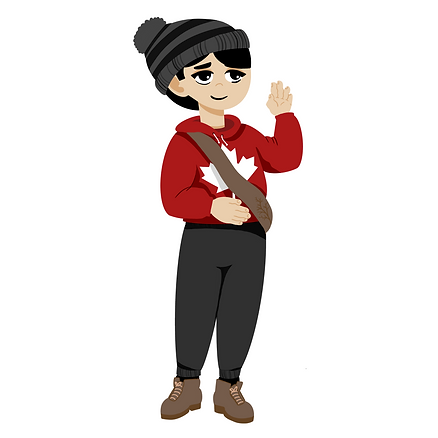

I used Microsoft Copilot to show them both in an A-pose and facing front.


Once the characters were finished, I rigged them. They were then ready for animation!
Environment Design
While working on the characters, I also modeled the exterior of the cabane à sucre. I later built the full interior by studying a wide range of real cabane à sucre references and combining elements from each. I designed and modeled all key props—tables, dishes, food, maple syrup containers, instruments, and Claudette’s gigueur—to create a warm, lively environment that felt authentic to the tradition.
Animation Workflow
With the characters and environment ready, I staged and animated each shot based on the storyboard. I handled lip‑syncing by matching the recorded dialogue to the character performances directly in Blender, refining timing until the expressions felt natural.
Integrating 2D & 3D Animation
A major creative challenge was incorporating 2D Grease Pencil characters into the 3D world. After testing different render passes and compositing approaches, I established a workflow that combined Cycles renders for the 3D elements with Eevee renders for the 2D drawings. I composited the passes in After Effects to ensure the 2D characters integrated cleanly into the scene.
Background Characters & AI Integration
To populate the cabane à sucre with additional guests under a tight deadline, I used AI‑generated characters for the background. I placed these characters throughout the environment and later incorporated AI‑generated dancing variations for the final sequence, ensuring the world felt full and energetic.
Rendering & Compositing
To meet the deadline, I rendered the animation across two laptops simultaneously—Cycles for the 3D passes and Eevee for the 2D passes. After compositing everything in After Effects, I assembled the final edit in Premiere Pro, adding dialogue, sound effects, and music to complete the video.
